
Self-driving cars are one of the most fascinating examples of how artificial intelligence is changing the real world. What once seemed like science fiction is now becoming increasingly important in autonomous vehicles, advanced driver-assistance systems, and robotaxi technology using AI in self-driving cars.
But how can a vehicle drive without a human controlling every movement?
The answer involves a combination of artificial intelligence, cameras, sensors, computers, maps, and advanced software.
AI in self-driving cars helps vehicles understand their surroundings, recognize objects, predict possible dangers, and make driving decisions. Artificial intelligence allows an autonomous vehicle to process information from cameras and sensors and respond to changing road conditions.
In this beginner-friendly guide, you will learn how AI is used in self-driving cars, how autonomous vehicles make decisions, which technologies they use, and what the future of AI-powered transportation may look like.
What Is AI in Self-Driving Cars?
AI in self-driving cars refers to the use of artificial intelligence technologies that help a vehicle observe its environment, understand what is happening around it, and make driving-related decisions.
A human driver uses their eyes, brain, experience, and judgment while driving. For example, a driver can:
- See a traffic light
- Recognize another vehicle
- Notice a pedestrian crossing the road
- Understand road signs
- Decide when to brake
- Predict what another driver might do
A self-driving car needs technology that can perform many similar tasks.
This is where artificial intelligence becomes essential.
AI allows the vehicle to process large amounts of information collected from cameras and sensors. The system can identify objects, analyze situations, predict what may happen next, and help determine the safest possible action.
In simple terms, AI gives autonomous vehicles the ability to perceive, analyze, predict, and respond to the world around them.
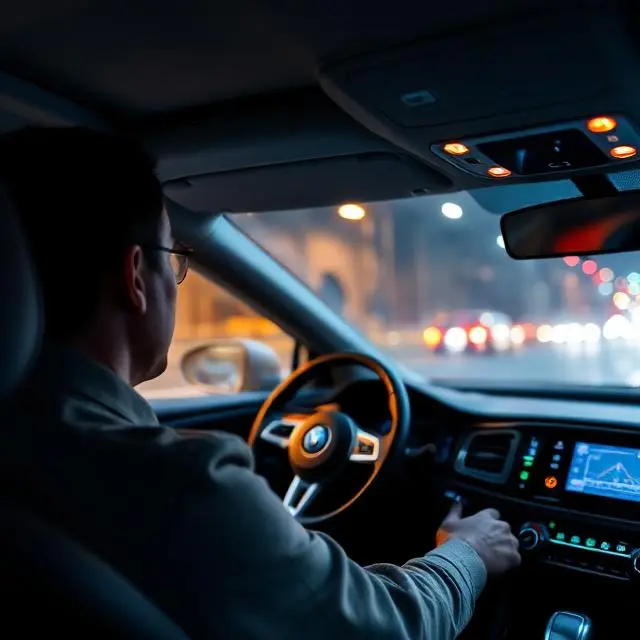
How Does AI Work in Self-Driving Cars?
A self-driving car does not depend on a single AI system.
Instead, several technologies work together to collect information, understand the environment, and control the vehicle.
The basic process can be explained like this:
Sensors collect information → AI analyzes the information → The system makes a decision → The vehicle responds
For example, imagine that a pedestrian suddenly walks toward the road.
The self-driving system may:
- Detect the person using cameras and sensors.
- Use AI to identify the object as a pedestrian.
- Calculate the person’s position and movement.
- Predict whether the pedestrian may enter the vehicle’s path.
- Decide whether the vehicle should slow down or stop.
- Send instructions to the braking system.
This process can happen extremely quickly.
However, autonomous driving is much more complicated than simply recognizing objects. The AI system must continuously analyze a changing environment where vehicles, pedestrians, cyclists, traffic signals, and road conditions can all change within seconds.
How Is AI Used in Self-Driving Cars?
AI is used in self-driving cars for several important tasks.
The main role of AI is to help the vehicle answer four essential questions:
- What is happening around me?
- What might happen next?
- What should I do?
- How should the vehicle respond safely?
AI helps autonomous vehicles perform tasks such as:
- Detecting vehicles and pedestrians
- Recognizing traffic signs and traffic lights
- Understanding road lanes
- Predicting the movement of other road users
- Planning a route
- Maintaining a safe distance
- Braking when necessary
- Assisting with steering and acceleration
This is why AI is considered one of the most important technologies behind autonomous vehicles.
Which AI Technologies Are Used in Self-Driving Cars?
Several AI technologies work together in autonomous driving systems.
1. Machine Learning
Machine learning allows computer systems to learn patterns from data.
Self-driving cars need to understand many different objects and situations, including:
- Cars and trucks
- Pedestrians
- Bicycles
- Traffic lights
- Road signs
- Animals
- Construction areas
- Different weather conditions
Machine learning models are trained using large amounts of data.
For example, an AI system can learn what pedestrians look like by analyzing many images and examples. It can then use that knowledge to recognize pedestrians in new situations.
Machine learning helps improve the ability of autonomous systems to recognize patterns and respond to complex environments.
2. Deep Learning
Deep learning is a type of machine learning that uses artificial neural networks to process complex information.
It is particularly useful for tasks such as:
- Image recognition
- Object detection
- Pattern recognition
- Understanding driving environments
For example, a deep learning system can analyze images from a vehicle’s camera and identify:
- Cars
- Trucks
- Pedestrians
- Traffic signals
- Road lanes
Deep learning plays an important role in helping autonomous vehicles understand complex visual information.
3. Computer Vision
Computer vision helps computers understand images and video.
Humans use their eyes and brains to understand what they see on the road. A self-driving vehicle uses cameras and AI systems to perform a similar task.
Cameras capture visual information, while AI analyzes that information.
Computer vision can help a vehicle recognize:
- Other vehicles
- Pedestrians
- Traffic signs
- Traffic lights
- Road markings
- Buildings
- Obstacles
This makes computer vision one of the most important technologies used in AI-powered autonomous vehicles.
4. Neural Networks
Neural networks are AI systems designed to recognize complex patterns in data.
They can process large amounts of information and help autonomous vehicles understand complicated driving situations.
For example, a neural network may help determine whether an object detected by a camera is:
- A person
- A bicycle
- A motorcycle
- A car
- A road sign
Neural networks are particularly useful when AI systems need to analyze complicated visual information and identify patterns.
What Sensors Are Used in Self-Driving Cars?
AI needs information before it can make decisions.
Self-driving vehicles use several types of sensors to collect information about the environment around them.
Cameras
Cameras capture visual information about the road and surrounding environment.
They can help AI systems identify:
- Road lanes
- Traffic lights
- Vehicles
- Pedestrians
- Road signs
However, cameras can be affected by darkness, heavy rain, fog, or other difficult weather conditions.
Radar
Radar uses radio waves to detect objects and measure their distance and movement.
It can help a vehicle understand:
- How far another vehicle is
- How quickly another object is moving
- Whether an object is approaching
Radar can be particularly useful in situations where cameras may have difficulty seeing clearly.
LiDAR
LiDAR uses laser technology to measure distances and create a detailed representation of the surrounding environment.
It can help a vehicle understand where objects are located and create a three-dimensional view of its surroundings.
LiDAR is one of several technologies that may be used to provide detailed environmental information to autonomous driving systems.
GPS and Digital Maps
Self-driving cars also need location information.
GPS can help determine where a vehicle is located, while digital maps can provide information about:
- Roads
- Intersections
- Routes
- Road layouts
However, GPS alone cannot safely operate a self-driving car.
The vehicle still needs AI and sensors to understand what is happening around it in real time.
How AI Makes Decisions in Self-Driving Cars
Recognizing objects is only one part of autonomous driving.
The vehicle must also decide what to do.
Imagine a self-driving car approaching an intersection.
The AI system may need to answer questions such as:
- Is the traffic light red or green?
- Is another vehicle approaching?
- Is a pedestrian crossing the road?
- Should the vehicle stop?
- Is it safe to turn?
AI systems analyze the available information and select an appropriate response.
This process is often explained in four stages:
Perception
The vehicle detects and understands its surroundings.
It collects information from cameras, radar, LiDAR, and other sensors.
Prediction
The AI predicts what other road users might do.
For example, it may estimate whether another vehicle is likely to change lanes or whether a pedestrian may enter the road.
Planning
The system determines the safest possible route or driving action.
Action
The vehicle responds by controlling systems such as:
- Steering
- Braking
- Acceleration
Together, these stages help explain how AI works in self-driving cars.
AI in Self-Driving Cars Examples
AI technology is already being used in different types of vehicles and driving systems.
Advanced Driver-Assistance Systems
Many modern vehicles use AI-assisted features such as:
- Lane assistance
- Automatic emergency braking
- Adaptive cruise control
- Parking assistance
- Collision warnings
These systems do not necessarily make a vehicle fully autonomous.
Instead, they use technology to assist the human driver with specific tasks.
Autonomous Vehicle Development
Companies and researchers continue to develop vehicles capable of performing more driving tasks automatically.
These systems may combine:
- Artificial intelligence
- Machine learning
- Computer vision
- Cameras and sensors
- Mapping technology
The goal is to create systems that can safely understand and respond to complex road environments.
AI in Self-Driving Cars vs Traditional Cars
Traditional cars depend mainly on human drivers to observe the road and make decisions.
AI-powered vehicles can assist with some of these tasks.
| Traditional Car | AI-Powered Vehicle |
|---|---|
| Human observes the road | Sensors collect environmental information |
| Human makes driving decisions | AI analyzes driving situations |
| Human controls braking and steering | Automated systems can assist with vehicle control |
| Human identifies hazards | AI can detect potential hazards |
| Human follows road lanes | AI can assist with lane positioning |
The level of automation can vary significantly between vehicles.
Some vehicles provide limited driver assistance, while others are being developed to perform more driving tasks with less human involvement.
Benefits of AI in Self-Driving Cars
AI could provide several important benefits for transportation.
1. Improved Road Safety
Human error contributes to many road accidents.
AI systems can continuously monitor their surroundings and do not become distracted or tired in the same way humans do.
However, AI systems can also make mistakes. This is why safety remains one of the most important challenges in autonomous driving.
2. Faster Reactions
AI systems can process information quickly.
When sensors detect a possible danger, automated systems may respond faster than a human in certain situations.
For example, automatic emergency braking can respond when the system detects a possible collision.
3. Assistance for Drivers
AI can make driving easier by helping with tasks such as:
- Parking
- Maintaining a safe distance
- Staying within lanes
- Detecting possible collisions
These technologies can reduce some of the workload placed on drivers.
4. Better Transportation Options
Autonomous technology could eventually provide new transportation options for people who cannot easily drive themselves.
This could potentially help:
- Older adults
- People with disabilities
- People who have limited access to transportation
However, many technical, legal, and safety challenges still need to be addressed.
5. More Efficient Traffic Systems
In the future, AI-powered transportation systems could help improve traffic flow.
Vehicles may eventually communicate with other systems and respond more intelligently to changing traffic conditions.
Challenges of AI in Self-Driving Cars
Although the technology is impressive, autonomous vehicles face major challenges.
Bad Weather
Rain, fog, snow, and other weather conditions can make it more difficult for cameras and sensors to understand the environment.
Autonomous systems must be able to operate safely in a wide range of conditions.
Complex Human Behavior
Humans can behave unpredictably.
A pedestrian may suddenly cross the road.
Another driver may make an unexpected turn.
AI systems must continuously predict and respond to uncertain situations.
Unusual Road Conditions
Roads are not always predictable.
A vehicle may encounter:
- Construction areas
- Missing lane markings
- Temporary signs
- Accidents
- Unexpected obstacles
These unusual situations can be difficult for autonomous systems to interpret correctly.
Safety and Reliability
A self-driving car must make safe decisions in countless different situations.
This requires extensive testing, careful engineering, and continuous improvement.
Even a small mistake can have serious consequences.
Cybersecurity
Connected vehicles may face cybersecurity risks.
AI-powered transportation systems need strong security measures to protect vehicles and users from unauthorized access.
Can AI Completely Replace Human Drivers?
At present, this remains a complex question.
AI technology has made significant progress, but driving in the real world involves countless unpredictable situations.
Human drivers use experience, judgment, and common sense when dealing with unusual situations.
AI systems can process huge amounts of information, but unusual or unexpected situations can still be difficult for them.
For this reason, the transition from human-driven vehicles to fully autonomous transportation is likely to be gradual.
We may continue to see more advanced AI-powered driving assistance systems before fully autonomous vehicles become common everywhere.
AI and Autonomous Driving: What Is the Connection?
AI and autonomous driving are closely connected because artificial intelligence helps vehicles understand their surroundings and make driving decisions. Autonomous driving AI uses technologies such as machine learning, computer vision, deep learning, and sensor data to detect objects, predict movement, and control vehicle actions.
The Future of AI and Self-Driving Cars
The future of AI in self-driving cars could be very exciting.
As artificial intelligence improves, autonomous systems may become better at:
- Understanding complex environments
- Predicting dangerous situations
- Navigating unfamiliar roads
- Responding to changing traffic conditions
Future transportation systems may also become increasingly connected.
Vehicles could potentially communicate with:
- Other vehicles
- Traffic management systems
- Road infrastructure
AI could play an increasingly important role in making transportation smarter and more efficient.
However, technology alone will not determine the future of self-driving cars.
Safety, regulations, infrastructure, cybersecurity, and public trust will all remain important factors.
Frequently Asked Questions About AI in Self-Driving Cars
How is AI used in self-driving cars?
AI is used to help self-driving cars understand their surroundings, recognize objects, predict possible movements, and make driving decisions. Machine learning, computer vision, and neural networks are important parts of autonomous driving systems.
How does AI work in self-driving cars?
AI works by analyzing information collected from cameras, radar, LiDAR, GPS, and other sensors. The system identifies objects, predicts possible situations, plans an appropriate response, and helps control the vehicle.
Which AI technology is used in self-driving cars?
Self-driving cars can use machine learning, deep learning, computer vision, neural networks, and other AI technologies to analyze information and make decisions.
What sensors do self-driving cars use?
Self-driving cars may use cameras, radar, LiDAR, GPS, and other sensors to collect information about their surroundings.
Can AI drive a car by itself?
AI can perform certain driving tasks and support different levels of automated driving. The level of automation depends on the vehicle, technology, and operating conditions.
What is the role of computer vision in self-driving cars?
Computer vision helps AI systems analyze images and video from cameras. It can identify vehicles, pedestrians, traffic signs, road lanes, and other important objects.
Are self-driving cars completely safe?
No technology can guarantee complete safety. Autonomous driving systems must deal with complex and unpredictable real-world situations, which is why extensive testing and safety development are essential.
Final Thoughts
AI in self-driving cars is one of the clearest examples of artificial intelligence being used to solve complex real-world problems.
A self-driving vehicle needs AI to do much more than simply travel from one location to another. It must understand its surroundings, recognize objects, predict possible dangers, and make decisions quickly.
Technologies such as machine learning, deep learning, computer vision, neural networks, cameras, radar, and LiDAR all play important roles in autonomous driving.
While fully autonomous driving still faces significant challenges, AI-powered vehicles and driver-assistance technologies are likely to continue developing in the coming years.
For beginners learning about artificial intelligence, self-driving cars provide a fascinating example of how multiple AI technologies can work together to understand and respond to the real world.
Suggested Reading
What Is AI in Finance Explained for Beginners (2026)
What Is Google AI Called? A Complete Guide to Google Gemini (2026)